- Trends in the confectionery industry in Ukraine in 2019
- A little about the sweet history
- The history of the cupcake
- How muffins came to be
- Where did the cake come from?
- What types of confectionery packaging are there?
- What materials is packaging made from:
- Interesting facts about the Ukrainian market:
- How to choose high-quality packaging for confectionery
- 7 rules for high-quality confectionery packaging
- Recommended Articles
Are you looking for confectionery packaging for cakes, cupcakes, gingerbread and other sweet treats? How do you choose truly high-quality packaging that will help boost sales?
Trends in the confectionery industry in Ukraine in 2019
Ukrainian sweets are a real source of pride for the Ukrainian people. Three of our confectionery companies are ranked among the world’s top 100. And this is against the backdrop of our economic situation and the near-total absence of the long history that many Western countries can boast of.
Moreover, all this is achieved without state support. Any sector supported by our government fails to succeed, whereas private companies thrive. Why? Perhaps one of the reasons lies in a sense of responsibility. One often gets the impression that government officials need to do everything ‘for show’ or for personal gain, whereas the owners of private companies understand that success lies in a high-quality product, and that they alone are responsible for its quality.
For a product to be in demand and able to compete with the global giants of the confectionery industry, a good recipe and high-quality ingredients are not enough. Modern, high-quality equipment and control over every stage of production are required, the final stage of which is selecting the right packaging for the products.
For Ukrainian consumers, sweets are not essential items. Sweets are most often bought to mark important occasions: the arrival of guests, anniversaries, and personal or public holidays. Small sweets—chocolates, bars, and biscuits—are bought as snacks. Advertising for sweets plays on consumers’ emotions, so it is important to present them correctly.


- product cost. Compared to imported goods, Ukrainian sweets are much more affordable;
- quality. Despite the lower price, our confectionery products can compete with many global manufacturers;
- ‘Made in Ukraine’ is not just three words, but a reason to support Ukrainian producers.
A little about the sweet history
People loved to enjoy sweets even in Ancient Egypt. Back then, however, they did not resemble modern sweets, but were a mixture of dates, nuts and honey. In Ancient Rome, sweets were made from nuts, honey, poppy and sesame seeds, whilst in Ancient Greece, the precursor to modern marmalade was invented. Sweet juice was poured into a flat vessel and evaporated in the sun, resulting in a sweet-and-sour, sticky mass. As for our ancestors, they adored candied fruit — pieces of berries and fruit preserved in honey.
In Europe, people ate sweets imported from Arab countries, and only began making their own in the 15th and early 16th centuries. The very word ‘confectioner’ comes from Italian and means ‘to cook in sugar’. The secrets of desserts were closely guarded; every noble household had its own confectioner with their signature treats. It got to the point of absurdity: at celebrations, guests would slip pieces of sweets into their sleeves so that, once home, their confectioner could try to decipher the recipe.
Chocolate also has a long history; it is over 3,000 years old and has Mexican roots. The cocoa drink was considered divine, bestowing youth and beauty. Christopher Columbus brought it to Europe, and it was here that the history of chocolate began to unfold. The greatest chocolate lovers live in Europe, and they are the Swiss.
Nowadays, you can find a vast range of confectionery products in every country around the world. We’ll focus on three: cupcakes, muffins and cakes.
The history of the cupcake


According to history, muffins first appeared when granulated sugar was brought to Europe from the American colonies.
Nowadays, muffins are one of the most popular treats during tea time and coffee breaks. The ideal size for this dessert is a small, round cupcake, just right for a cup of fragrant tea or delicious coffee.
How muffins came to be
England gave the world muffins. The dessert appeared in the 18th century, and the origin of its name is not entirely clear. The main theory is that it derives from the Old French ‘mouffle’, meaning ‘slightly soft’ and describing the quality of bread. Another theory suggests it comes from the Old German word ‘muffen’ — ‘small cakes’. In England, the word ‘muffin’ refers to a bun served with tea.
However, whatever the word originally meant, it now instantly evokes appetising associations and thoughts of a cosy and delicious tea party with treats.
English muffins resemble a flat cake, which is sometimes lightly toasted over a flame and served with traditional jelly or jam. Originally, however, this type of sweet pastry was not found on the tables of the aristocracy, but was intended for ordinary workers.
English muffins are made from yeast dough, whilst American ones are made from unleavened dough. It was the Americans, in fact, who came up with the idea of adding a wide variety of ingredients to the dough:
- berries or pieces of fruit;
- syrups;
- fudges;
- vanilla sugar;
- coconut flakes and much more.
Where did the cake come from?
It is difficult to say exactly which country gave the world this much-loved dessert.
One theory suggests that the cake originated in Italy. The reason lies in the etymology of the word, which in Italian means something intricate and elaborate. Many believe this relates to the cake’s decorations, such as cream flowers, swirls and ornaments.
A second theory suggests that the cake derives from Eastern sweets, which, with their enchanting aroma and delicate, refined flavour, can captivate any sweet tooth. Ancient Eastern sweets, made from honey, milk and sesame seeds, resembled modern cakes in shape.
It is worth noting that, regardless of which part of the world the cake originated from, the French played a key role in its development and current appearance. Skilled confectioners perfected dessert recipes in their small cafés and coffee shops and gifted the world the sweetest words: cream, meringue, caramel, sponge and jelly. And then they ensured that the cake became the world’s favourite dessert. Why the favourite? 99% of celebrations end with a cake being served. Birthdays, weddings, name days and many other celebrations are unthinkable without a cake.
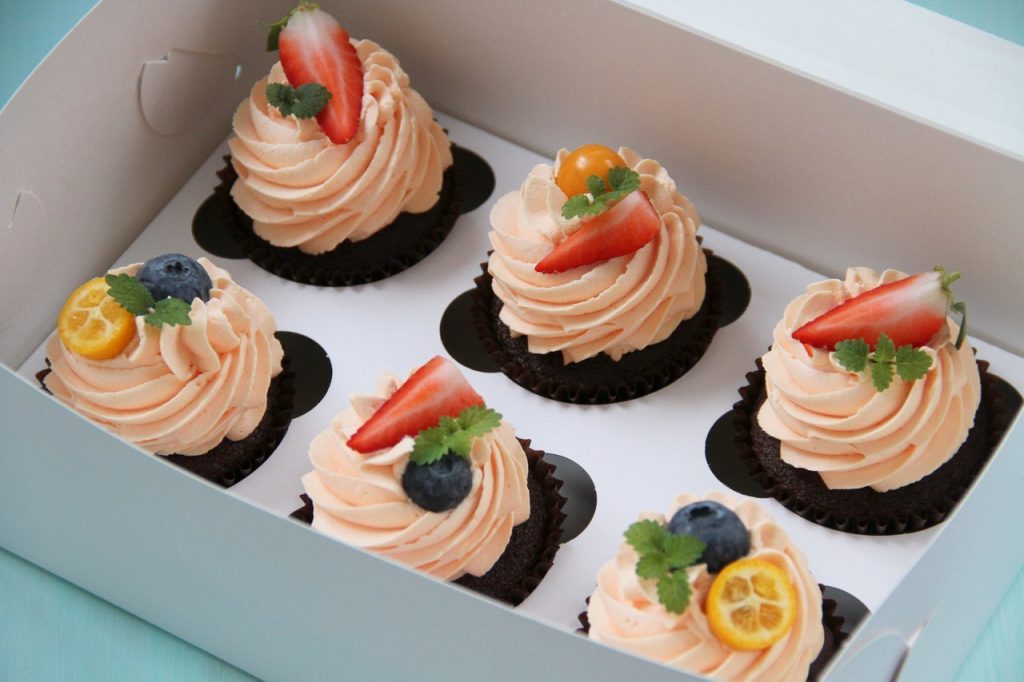
For most people, a square or round box evokes a sense of joy and pleasant associations. That is precisely what we will discuss next — the correct presentation of mouth-watering sweets.


What types of confectionery packaging are there?
Confectionery products require individual packaging. Thanks to this:
- hygiene standards are maintained during storage and transport;
- the shelf life of the products is extended;
- the product becomes more attractive.
Packaged goods sell in greater quantities than unpackaged goods sold by weight.
Consumers like neat boxes, especially for desserts whose shape can easily be damaged during transport: muffins, cakes or pastries. Furthermore, packaging, including confectionery packaging, can enhance brand recognition.
What else do consumers value? Boxes that are easy to open but remain functional after opening. For example, it is difficult to eat a whole cake in one go, so it can be placed in the fridge straight in its packaging. Packaging must be practical and ergonomic.
What materials is packaging made from:
- cardboard, less commonly thick paper;
- metal;
- wood;
- polymers;
- composite materials.
Interesting facts about the Ukrainian market:
- In the Ukrainian confectionery market segment, cardboard and polymers are most commonly used.
- Metal (for example, round tin tins for biscuits or sweets) and wood are suitable for gift packaging or as premium options, which are rarely found on supermarket shelves.
- Combined packaging, on the other hand, is not uncommon on the Ukrainian market; for example, chocolate sweets are packaged in cardboard boxes and film.
- Cardboard and paper are valued for their compactness, light weight and environmental friendliness. They can be easily used to create boxes, crates, labels, wrapping paper and so on. The main drawback of paper packaging is that it deteriorates when exposed to moisture and does not provide very reliable protection against external odours.
Packaging options:
- Doy-pack. May have a screw-off cap or a zip fastener; it can also be opened with scissors. Suitable for small sweets: dragees, glazed nuts, sweets and more;
- flow-pack. Bags with three seams that provide reliable protection against moisture. If a metallised film is added, the packaging can also protect against sunlight;
- box. A common option for various sweets. Boxes are available with or without a film window. The combination of cardboard and transparent film is ideal for packaging confectionery products. Thanks to the cardboard box, the products are packed compactly and stylishly, whilst the film protects against moisture, extends the shelf life and adds appeal with its glossy finish.
- Blister pack. Inexpensive individual packaging that extends shelf life. It comes as a double-sided blister box, with a cardboard backing, and as a heat-sealed blister pack, which is rarely used;
- Corrugated cardboard. Polymer-based packaging. Suitable for sweets that can easily lose their appearance and therefore need to be stored individually in their own compartment: marshmallows, marmalade, and assorted chocolate sweets. In tin packaging, they retain their appearance even during transport;
- tin. Not commonly found; many people buy such sweets as gifts for special occasions, so limited editions are often released for New Year, Valentine’s Day and 8 March;


How to choose high-quality packaging for confectionery
First and foremost, you need to understand the functions of confectionery packaging:
- it protects the product from external factors;
- it labels the confectionery;
- it attracts attention.
Furthermore, boxes and other confectionery packaging must be safe and extend the shelf life. Confectionery boxes and packaging must meet standards, appeal to customers and be easy to open.
7 rules for high-quality confectionery packaging
Based on our 14 years of manufacturing experience, we have compiled the basic rules that confectionery packaging must adhere to.
- Compatibility with the product. Consider not only the dimensions of the products but also their specific characteristics. Fragile chocolate must be packed in sturdy material; for sweets affected by light, choose containers made of thick foil and cardboard; products with a high fat content must not be stored in plastic film or paper bags, etc.
- Storage convenience. Bear in mind that the packaging will be displayed in supermarket display cases and on shelves; it must be the correct shape and, preferably, feature transparent inserts to serve as additional product advertising.
- Simplicity. Complex, ornate designs are suitable for exhibitions or exclusive orders. Cardboard or plastic packaging for confectionery should be simple, easy to transport and convenient for shelf display.
- Reusability. This is good for the environment and appeals to customers. More and more people are taking this into account. If you use good-quality materials that can be recycled, the loyalty of such customers to your products will grow.
- Appropriateness for the product category. Expensive sweets or exclusive chocolate should have packaging that matches their status. For cheaper confectionery, choose high-quality but simple designs.
- Product presentation. Confectionery boxes are the first to tell the story of the product. The ingredients and production date must be easy and quick to find. A company logo is a must.
- Appetising appearance. Consider colours and images. Bright and vibrant packaging for confectionery instantly whets the appetite, even among well-fed customers.