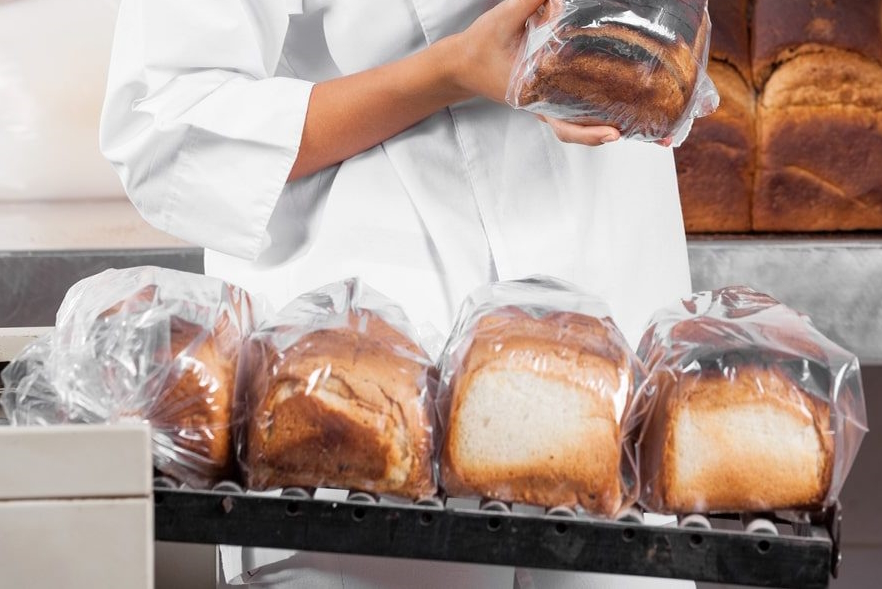
Bread is a product that requires special protection. The wrong type of packaging can lead to the bread becoming dry, developing condensation, or spoiling quickly. To avoid losses and maintain product quality on the shelf, it is important to choose packaging that really works.
In this article, we’ll explain how to choose the right packaging for bread and pastries and which materials provide the best storage conditions.
1. The right material: BOPP or CPP?
Choosing between BOPP and CPP is one of the key steps in selecting packaging for bakery products. Both materials are types of polypropylene film, but they have different properties and are suited to different applications.
BOPP — Biaxially Oriented Polypropylene
What it is:
A film oriented along two axes (longitudinally and transversely), making it strong, tear-resistant and of consistent thickness.
Advantages of BOPP:
Transparency and gloss — showcases the appearance of bread or rolls on the shelf.
Rigidity and shape retention — the packaging retains its shape, does not crease and looks neat.
Resistance to moisture and grease — does not absorb moisture, suitable for products with moderate moisture content.
Printability — ideal for flexographic printing, including full-colour.
Perforation capability — preserves the crispness of the crust and prevents condensation.
Suitable for:
Baguettes, rolls, pastries
Products with a short shelf life
Packaging with a transparent window or design
CPP — Cast polypropylene
What it is:
A film manufactured using the cast method; it is non-oriented, making it softer and more elastic.
Advantages of CPP:
Puncture and tensile strength — protects bread with a crust, toppings or non-standard shapes.
Sealing and barrier properties — retains moisture and protects against air.
High sealability — suitable for automated lines and flow-pack packaging.
Matt or semi-matt finish — gives the packaging a premium look.
Ideal for:
Filled bread and bread with high moisture content
Puff pastries, croissants, cheesecakes
Products with a long shelf life
Fully sealed bags
Comparison of BOPP and CPP in a table
Property
BOPP
CPP
Transparency
Very high
Medium / semi-matt
Tensile strength
Average
High
Moisture resistance
Good
Excellent
Sealing capability
Yes
Yes (it holds the solder joint better)
Suitable for printing
Yes
Yes (and sometimes the paint doesn’t last as well)
Uses
Standard baked goods
Perishable and non-standard products
2. Optimal packaging density for bread
The density of the packaging material (more specifically, the thickness of the film) is one of the key factors affecting the preservation of bakery products. The thickness determines the strength, appearance, perceived quality and compatibility with equipment. Insufficient thickness poses a risk of tearing. Excessive thickness increases production costs. It is important to strike a balance.
Thickness is measured in microns (μm): 1 μm = 0.001 mm.
The higher the density:
the stronger the packaging,
the lower the risk of tearing during packaging or transport,
but the higher its cost.
What to consider when choosing:
Product weight and shape
The heavier the product, the greater the load on the base of the bag and the seal.
Example: an 80 g bun — 25 µm is sufficient; a 500 g loaf — 35–40 µm is required.
Sharp corners, crusts, and toppings (seeds, sugar) increase the risk of tearing.
Packaging type (manual or automatic)
Automatic lines (flow-pack) require consistent thickness and good sealability.
Manual packaging allows for the use of thinner, more flexible material.
Shelf life
For products with a short shelf life (up to 24 hours), bags with lower density can be used.
For packaging sliced bread or products with an extended shelf life — higher density is required, and barrier properties may be necessary.
Consumer requirements
Retail chains often specify requirements for bag thickness and type (e.g., transparent 30 µm BOPP with a Euro-slot).
Some customers focus on the ‘perceived quality’ — a thick bag is perceived as more reliable.
How do you calculate the required thickness?
There is no universal mathematical formula, but there is a recommended approach:
Thickness = Base thickness + Coefficients (weight, shape, packaging method)
Sample template:
Product type
Weight (g)
Odds
Recommended density
Pastry/bun
up to 150
hand-packed, smooth surface
25–27 μm
Baguette
300–600
sharp corners, automatic packaging
35–40 μm
Stuffed bread
200–500
high humidity, airtightness
30–35 μm
Sliced bread
250–400
crumb guard, presentation
30–35 μm
Shrink-wrapping
любой
strength + thermoforming
from 40 μm
Tips for choosing:
– Don’t order ‘more than you need’ – you’ll end up paying 15–20% extra for the film.
– Don’t choose one that’s too thin – you risk producing defective products and unhappy customers.
– Always carry out a test run on your equipment before placing a bulk order. We’ll send you a free sample bag for this purpose!
– Don’t choose film that’s too thin — you risk defective products and dissatisfied customers.
– Always test the film on your equipment before placing a bulk order. We’ll send you a free sample pack for this purpose!
Looking for a precise match?
We calculate the thickness based on: product weight, packaging method (manual/automatic), required shelf life, and the customer’s visual requirements. Submit a request — and our manager will select the thickness and type of packaging specifically tailored to your production.
3. Protection against moisture and condensation
One of the main tasks of packaging for bakery products is regulating moisture exchange. Bread ‘breathes’ — immediately after baking, it retains heat and releases moisture. If this moisture is trapped in an airtight bag, the product quickly loses its quality: the crust goes soft, it becomes sticky, and mould and an unpleasant smell develop. Conversely, if the packaging is too open, the bread will go stale in a matter of hours.
Therefore, the choice of packaging must strike a balance between airtightness and ventilation. Here’s how it works:
Why does condensation form?
Hot or warm bread is packaged too soon.
The packaging does not allow air to pass through.
The temperature difference between the product and the surrounding environment.
Lack of micro-perforations.
Condensation = texture deterioration + risk of mould growth.Important: protection against moisture ≠ complete ‘breathability’
Packaging that is too open is also a problem. It leads to rapid drying out, especially when stored on open shelves, in air-conditioned rooms or in refrigerated display cabinets.
What should you choose?
Product type
Recommended packaging type
Fresh baguette
Perforated BOPP
Cheese cake, puff pastry
Microperforation in CPP
Sliced loaf
Sealable bag with micro-perforations
Filled pastry
Wicket bag with clip or CPP bag
Automatic packaging
Wicket or flow-pack (CPP)
What are the barrier properties of packaging?
Barrier properties refer to a material’s ability to limit the penetration of the external environment into the packaging and vice versa. For bakery products, three key parameters are important:
Property
What does it protect?
Why is it important?
Vapour permeability
Due to moisture evaporation
To prevent bread from going stale
Gas permeability
To prevent oxygen ingress
To prevent oxidation and mould
Grease resistance
To prevent the packaging from getting wet
This is particularly important for pastries and filled products
How does packaging affect shelf life?
A standard loaf in a paper bag: 12–24 hours — loses moisture quickly and becomes stale.
Bread in perforated BOPPB : up to 48 hours — retains its crispness but loses its softness.
B Bread in an airtight CPP bagB : up to 3–5 days — remains soft, especially if sliced.
B Bread in barrier packaging with MAP (modified atmosphere packaging)B : up to 7–10 days and longer — used in large bakeries.
In reality, the optimal shelf life for pre-packaged bread in a supermarket is 2–4 days. That is exactly how long the product has to reach the customer and be sold.
Which materials provide the necessary protection?
Material
Vapour/gas barrier
Suitable for
BOPP
Medium
Rolls, loaves, baguettes
CPP
Elevated
Pastries, filled bread
Multilayer wraps (BOPP/CPP/PE)
High
Packaging with a long shelf life
Wrap with an anti-fog (AF) coating
Yes
Products with a high moisture content
How can you extend the shelf life without changing the recipe?
Choose packaging with the right thickness and barrier properties.
Use micro-perforation to prevent condensation.
Pack the bread only once it has cooled down — warm bread causes condensation.
Take humidity and temperature into account during transport and storage.
Why is this beneficial?
↓ Fewer returns from shops
↓ Less wastage in the warehouse
↑ Longer shelf life — higher sales
↑ You can enter retail chains with pre-packaged products
5. Packaging type and presentation format
Even with perfectly selected materials (BOPP, CPP, etc.), the effectiveness of the packaging largely depends on its format and design.
It is the shape of the packaging that influences:
Why should you order bread packaging directly from the manufacturer?
💰 Save up to 30% — no middlemen
📐 Manufactured to your specifications
🚛 Uninterrupted supplies for your production
Frequently asked questions
What type of packaging is best suited for bread?
Perforated BOPP bags are most commonly used for packaging bread — they allow air to circulate well, prevent condensation and keep the bread crisp.
Can I order packaging with a logo?
Yes, we produce bags with custom printing and branding. This is a great way to make your product stand out on the shelf.
What packaging material should I choose for pastries?
For pastries with high moisture content, it is best to use CPP bags — they are more elastic and puncture-resistant.
What is the minimum order quantity?
We are manufacturers and produce packaging to the customer’s specifications. The minimum order quantity depends on the type of packaging. For transparent bags — from 5,000 pieces. For branded bags — from 150 kg of product. Please check with your account manager.